
What Drone Swarms Might Look Like In The Maritime Environment
Drone swarms are shifting from experimental defence projects into something closer to operational reality, and the maritime domain is where their impact may be most disruptive.
From contested choke points like the Strait of Hormuz to the open waters of the Indo-Pacific, naval planners are increasingly treating swarming systems as a core feature of future conflict rather than a niche capability. What is emerging is not just a new platform, but a new model of maritime power built on distributed autonomy, mass, and coordination.
© HIATUS
From platforms to collective behaviourAt its simplest, a maritime drone swarm is a network of unmanned systems operating together under shared control logic, often with varying degrees of autonomy. These systems can be surface vessels, aerial drones, or underwater vehicles, working in concert to overwhelm sensors, complicate targeting, and dilute traditional defensive advantages.
Research suggests that the value of swarming is less about individual platform capability and more about collective behaviour, where the group acts as a single adaptive system rather than discrete assets (4).
The constraints of the maritime environmentUnlike land or air domains, the sea introduces serious operational friction. Water limits communications, slows manoeuvre, and degrades sensing. That matters, because it forces a different kind of swarm design.
Naval drone swarms are therefore likely to rely on intermittent communication, pre-programmed logic, and distributed autonomy rather than continuous operator control. Recent AUKUS experimentation reflects this shift, with partners actively testing coordinated swarm tactics as part of broader naval integration (1).
Surveillance at scaleOne of the most immediate applications is surveillance. Swarms of low-cost surface and aerial drones could establish dense, persistent monitoring grids across critical maritime corridors.
Instead of relying on a small number of high-value assets, navies could deploy large numbers of expendable systems to maintain situational awareness. The effect is redundancy at scale, making it far harder for adversaries to degrade a fleet’s sensing capability through targeted strikes.
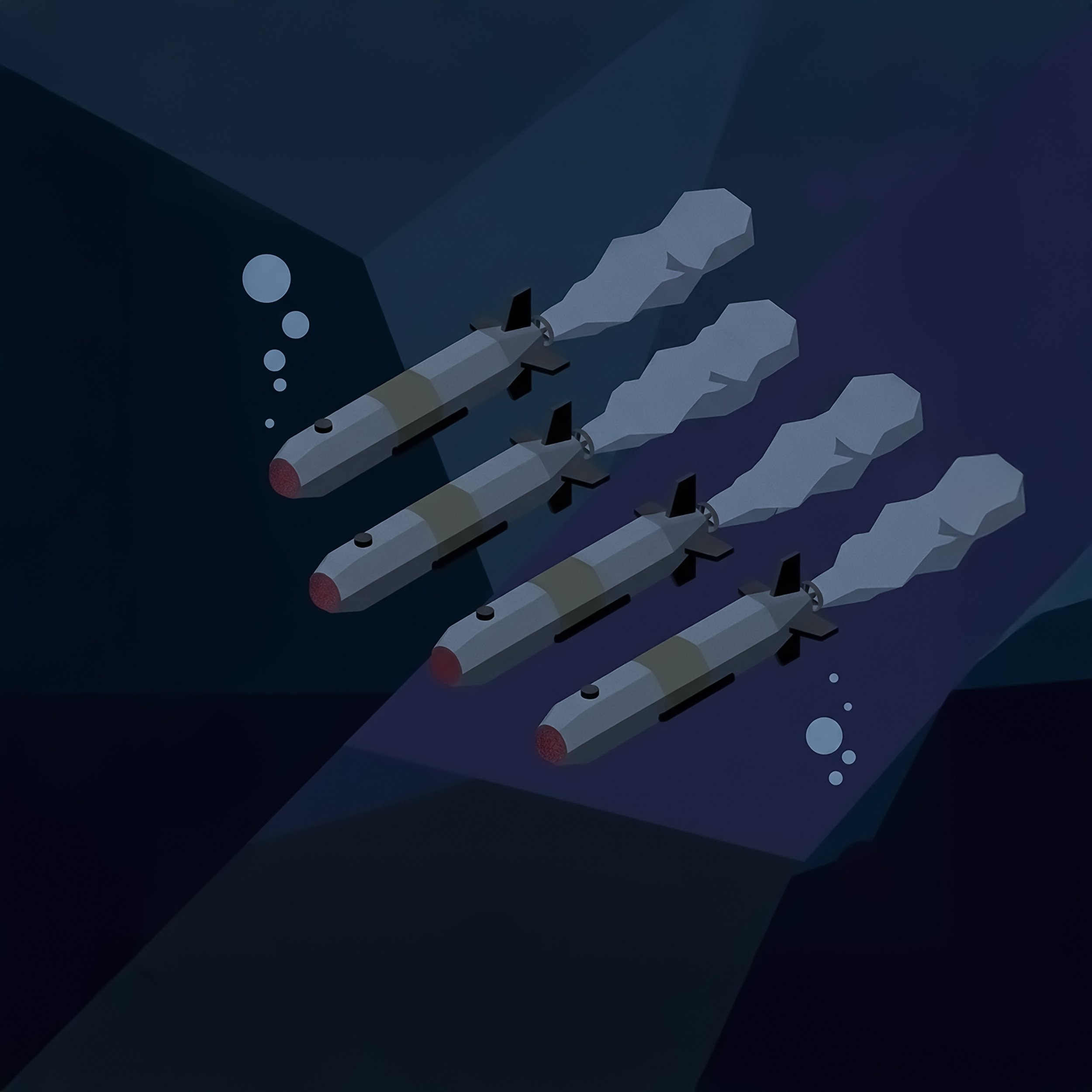
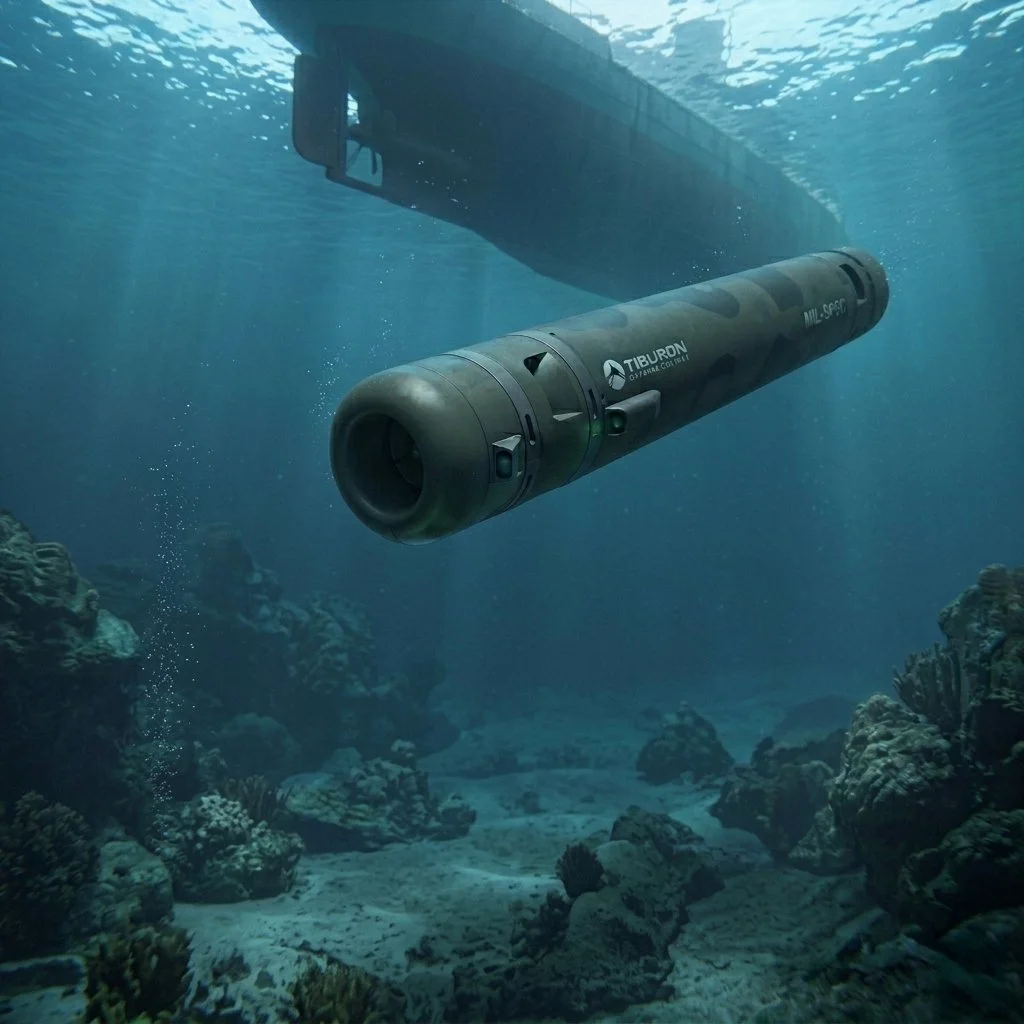
The underwater dimensionUnderwater swarming adds a second, more complex layer. Autonomous underwater vehicles operating in coordinated groups are already being explored for roles such as mine countermeasures, seabed mapping, and covert tracking (5).
The challenge is communication. Underwater environments severely restrict connectivity, meaning swarm behaviour would need to be heavily decentralised. In effect, these systems may operate more like distributed autonomous cells than tightly coordinated formations.
Tim Taylor, CEO of HAUV company, Tiburon, who has spent years operating autonomous systems underwater, highlights that the technology gap is no longer sensing, but coordination:
"I've spent years watching a single AUV work a target thousands of metres down, patient and precise, but essentially alone. The sensors and ambition are already here.
What is still catching up is the control technology, manoeuvrability and real-time coordination needed for underwater vehicles to act as one system rather than many. Until that matures, the underwater swarm, unlike its aerial counterpart, remains more concept than capability."

Asymmetric offensive powerSwarming also changes the logic of maritime strike. Small, fast, expendable drones can be deployed in large numbers to saturate traditional naval defences. This reflects a broader shift towards asymmetric maritime warfare, where mass and coordination can offset platform superiority (3).
Even highly advanced warships may struggle to respond to dozens of simultaneous, adaptive threats, particularly when those threats are designed to behave unpredictably.
A shift in naval economicsPerhaps the most profound change is economic. Naval power has traditionally depended on a small number of extremely expensive platforms. Swarms invert that model.
Instead of a few high-value ships, operators can deploy large numbers of relatively cheap systems designed to be lost. This introduces strategic expendability at scale and forces a rethink of deterrence models, particularly for NATO navies assessing emerging maritime vulnerabilities (2).
Defence and counter-swarm systemsDefending against swarms is not simply a question of firepower. It is a systems problem. Research suggests future counter-swarm strategies will rely on layered defence networks combining electronic warfare, directed energy systems, and automated interceptors (9).
The challenge is cognitive as much as technological. Even advanced systems may struggle to prioritise and respond to threats arriving at swarm density and speed.
Swarms as information warfareBeyond kinetic effects, swarms introduce a second battlefield: perception. Drone swarms can be designed to overload radar systems, distort signatures, or generate false targeting data.
In this sense, they operate as much as information weapons as physical ones, shaping what sensors believe is happening rather than just delivering physical effects (4). This creates a contested information layer above the sea itself.
A distributed maritime futureThe maritime battlespace is increasingly moving away from linear engagements and towards networked conflict. Naval operations may depend less on individual platform capability and more on software-defined coordination, data integrity, and communication resilience.
The broader implication is a gradual erosion of traditional maritime deterrence. Swarms lower the cost of force projection, expand access to naval power, and introduce uncertainty into previously stable hierarchies of control.
Current testing programmes, including multinational efforts like AUKUS, suggest this is no longer theoretical (1). The remaining question is not whether maritime swarms will exist, but how quickly they will scale from experimentation into doctrine.
What is emerging is a new kind of naval system, not defined by ships alone, but by distributed intelligence operating across surface, air, and underwater domains simultaneously.
You Might Also Like Our Podcast:







References
1. Australian Government Department of Defence. (2026, June). AUKUS partners test drone swarming tactics. https://www.defence.gov.au/news-events/news/2026-06-22/aukus-partners-test-drone-swarming-tactics
2. Center for European Policy Analysis. (n.d.). Sea drone swarms: Can NATO navies avoid Russia’s fate?https://cepa.org/article/sea-drone-swarms-can-nato-navies-avoid-russias-fate/
3. Center for International Maritime Security. (n.d.). Hormuz and the era of asymmetry: Sea mines, unmanned systems and the redefinition of naval
4. Conte, C., Verini Supplizi, S., de Alteriis, G., Mele, A., Rufino, G., & Accardo, D. (2022, Dec). Using drone swarms as a countermeasure of radar detection. Journal of Aerospace Information Systems, 20(2), 70–80. https://arc.aiaa.org/doi/10.2514/1.I011131
5. European Defence Agency. (2026, Feb). EDA project develops technology for underwater drones to move in swarms. https://www.eda.europa.eu/news-and-events/news/2026/02/17/eda-project-develops-technology-for-underwater-drones-to-move-in-swarms
6. Georgetown Security Studies Review. (n.d.). Swarm at sea: Autonomous naval drones and the erosion of maritime deterrence. https://gssr.georgetown.edu/the-forum/topics/technology/swarm-at-sea-autonomous-naval-drones-and-the-erosion-of-maritime-deterrence/
7. MGI Defence. (n.d.). Drone swarm tactics: How coordinated UAVs are changing the battlefield. https://mgidefence.co.uk/drone-swarm-tactics-how-coordinated-uavs-are-changing-the-battlefield/
8. Rhein, F., et al. (2025). MARESEC 2025 paper 20 [Conference paper]. German Aerospace Center. https://elib.dlr.de/221367/1/MARESEC_2025_paper_20.pdf
9. United States Naval Institute. (2022, Dec). Responding to drone swarms at sea. Proceedings. https://www.usni.org/magazines/proceedings/2022/december/responding-drone-swarms-sea